Guide
Leveling the bed and dialing in a perfect first layer
The paper test, Z-offset, auto leveling and how to read your first layer to know what to fix.
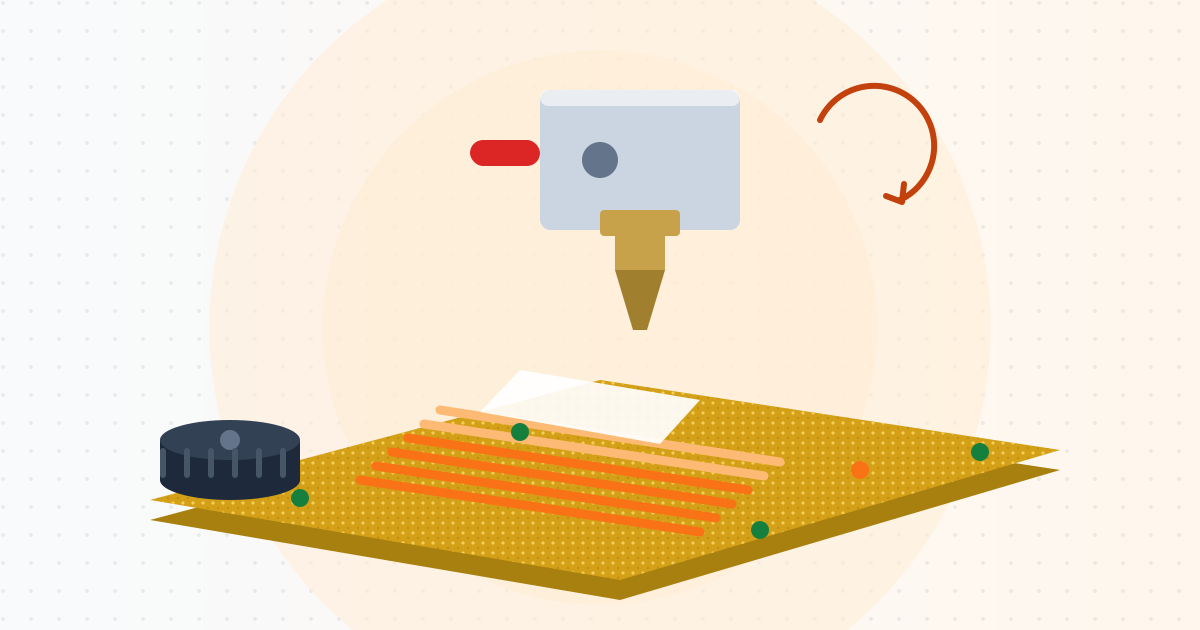
More than half of FDM failures start at the first layer: lifted corners, poor adhesion, a rough bottom or a nozzle scraping the bed. This guide fixes two things: bed flatness relative to the nozzle and the Z-offset.
Concepts
- Bed leveling: making the nozzle-to-bed distance equal everywhere. Beds are never perfectly flat, so modern printers probe a mesh to compensate.
- Z-offset: the distance between where the probe triggers and where the nozzle really is. Auto leveling does not replace setting the Z-offset.
Preparation
- Clean the hot nozzle with a brass brush (careful, it burns).
- Wipe the bed with 90%+ isopropyl alcohol – fingerprints kill adhesion.
- Heat bed and nozzle to normal print temperatures (PLA: bed 60°C). Always level hot.
Step 1: Manual four-corner leveling
- Home, then disable steppers so you can move the head by hand.
- Place a sheet of A4 paper (about 0.1 mm) under the nozzle at the front-left corner.
- Turn the knob until the paper drags slightly but still slides.
- Repeat for the other corners and the center, then do a second pass.
Step 2: Auto leveling
Run Auto Leveling / Bed Mesh (16–25 points) and save it. Make sure your start G-code loads the mesh after G28 (for example M420 S1 on Marlin).
Step 3: Z-offset
Lower Z in 0.05 mm steps at the bed center until the paper drags, then save. Values are usually negative (-1.20 to -2.50 mm depending on the machine).
Step 4: Print a first-layer test
Print a single-layer 100 × 100 mm square or five small squares (corners plus center).
| What you see | Cause | Fix |
|---|---|---|
| Round lines with gaps | Nozzle too high | Lower Z-offset 0.02–0.05 mm |
| Flat, fused, smooth lines | Correct | Save |
| Rippled surface, plastic piling up | Nozzle too low | Raise Z-offset 0.02 mm |
| One corner good, another gappy | Bed not flat | Re-level corners, rerun mesh |
Use babystepping during the print, then save the value.
Adhesion tips
- First-layer speed 20–25 mm/s, first-layer height 0.24–0.28 mm for a 0.4 mm nozzle.
- Fan off for the first 1–2 layers; use a 5–8 mm brim for small footprints or PETG/ABS.
- On PEI, raise Z-offset by 0.02–0.05 mm for PETG, which can bond so hard it tears the coating.
When to replace the sheet
Deep scratches, peeling coating or a warped sheet make an even first layer impossible. Replace it with a sheet like the MakerLab 235×235mm magnetic PEI sheet. Consumables are not covered by warranty, so let parts cool before removing them and never scrape with a blade.
Level hot, set Z-offset with paper then refine with a real print, and keep the bed free of finger oil – that solves most first-layer problems.